

Online Slots in Singapore: RTP, Volatility and Paylines Explained for Players
Open a modern slot game and there is plenty competing for your attention. Bright graphics, bonus symbols, free spins, animated characters and oversized jackpot figures can make the game look simple. Spin the reels, match a few symbols and see what happens.
Behind that colourful interface, though, are a few numbers and mechanics that tell you much more about how the game actually behaves.
For anyone researching online slots in Singapore, three terms are worth understanding before anything else: RTP, volatility and paylines.
They do not tell you what will happen on your next spin. Slots are games of chance, and no statistic can predict an individual result. What these features can do is help you understand how a slot has been designed, how frequently payouts may occur over extended play and what sort of payout pattern the game is intended to produce.
At Winbig SG, we believe those details are far more useful than choosing a slot simply because the artwork looks good.
This guide breaks them down in plain language.
First, What Actually Determines How an Online Slot Plays?
Two slot games can look almost identical and behave completely differently.
One might produce relatively frequent small wins. Another could go through longer periods without a meaningful payout but be designed with the possibility of larger wins when certain combinations land.
That difference often comes down to the mathematics behind the game.
Three characteristics give players a useful starting point:
RTP describes the theoretical percentage of wagered money a game is designed to return over a very large number of plays.
Volatility describes the general balance between the frequency and size of potential wins.
Paylines determine which symbol combinations can qualify as winning combinations.
Understanding all three gives you a much clearer picture of a game’s structure.
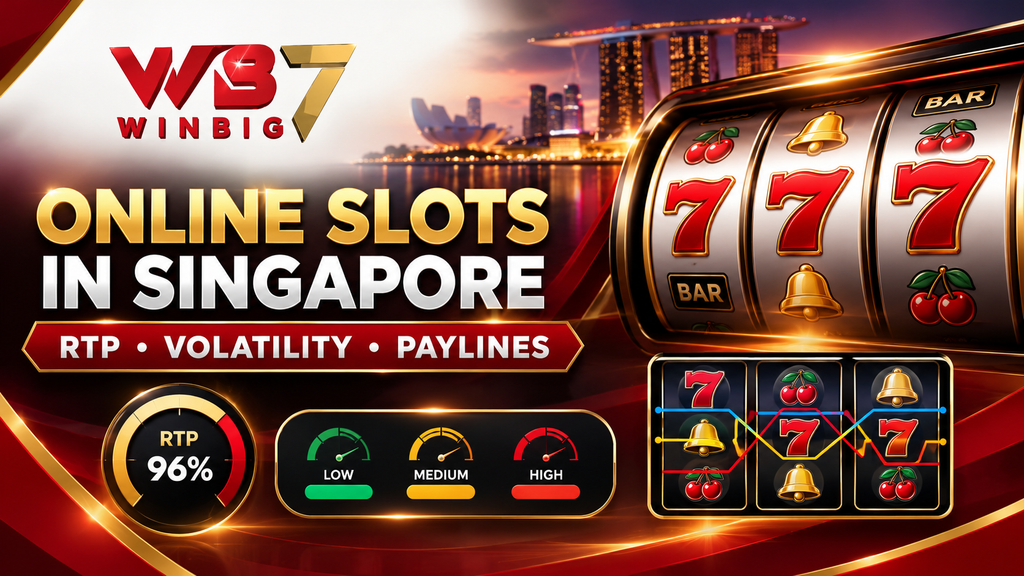
Slot RTP Explained Without the Technical Jargon
RTP stands for Return to Player.
If you have ever seen a slot showing something such as 95.5%, 96% or 97% RTP, that percentage represents a long-term theoretical return built into the game.
Here is the important part of slot RTP explained properly: RTP is not a promise about what one player will receive.
Imagine a slot with an advertised RTP of 96%.
That does not mean depositing S100automaticallyresultsinS96 coming back. You might finish above your starting amount, lose the entire amount or land somewhere in between.
The 96% figure is calculated across a very large number of game rounds. Individual playing sessions can vary considerably because each outcome is based on chance.
This distinction matters because RTP is often misunderstood.
A player may see a 96% RTP and assume there is only a 4% chance of losing. That is not how the number works. RTP describes the theoretical return generated by the game’s mathematical model over extensive play, not the probability of winning one particular spin.
Is a Higher RTP Always Better?
When comparing similar games, a higher theoretical RTP can be useful information.
For example, suppose two slots have comparable features:
| Game | Theoretical RTP |
| Slot A | 94.5% |
| Slot B | 96.5% |
Viewed strictly from a theoretical long-term return perspective, Slot B has the higher RTP.
But that still does not tell you everything.
Slot B might be highly volatile, producing fewer wins but potentially larger ones. Slot A could offer more frequent lower-value results.
This is why comparing RTP without looking at volatility can give you an incomplete picture.
Think of RTP as one part of the game’s identity, not a score that predicts how successful a particular playing session will be.
What Does Slot Volatility Mean?
Volatility, sometimes called variance, tells you about the expected pattern of payouts.
It is generally grouped into three broad categories: low, medium and high volatility.
The concept is easier to understand than it sounds.
A low volatility game tends to be designed around more frequent but generally smaller wins.
A high volatility game typically produces wins less frequently, while allowing for the possibility of comparatively larger payouts.
Medium volatility sits somewhere between those two approaches.
Neither type is automatically better.
The right choice depends largely on what sort of experience a player prefers.
Low Volatility Slots: More Frequent, Smaller Wins
Low volatility slots are often designed for players who prefer a steadier style of gameplay.
Instead of waiting a long time for a major winning combination, the game may deliver smaller winning results more regularly.
Imagine two people sitting down with the same entertainment budget.
One enjoys seeing regular activity on the balance and dislikes long stretches without a winning combination. That player may find low volatility slots more comfortable.
The attraction is not necessarily the possibility of a dramatic payout. It is the pace.
Frequent smaller wins can make the playing session feel active, although those wins do not necessarily mean a player is making an overall profit. A win can also be smaller than the amount originally wagered.
That detail is easy to overlook.
High Volatility Slots: Fewer Wins With Bigger Potential Swings
At the opposite end are high volatility slots.
These games are usually designed around less frequent winning combinations, with a greater emphasis on the possibility of larger payouts.
That creates a very different experience.
A player might encounter several unsuccessful spins before seeing a significant combination. Balance movements can therefore feel sharper, particularly when compared with low volatility games.
Some players like that structure because they enjoy the anticipation surrounding bonus rounds, multipliers or premium combinations.
Others find it uncomfortable.
Neither reaction is wrong. It is simply a matter of understanding what the game has been designed to do.
When reviewing online slots in Singapore, checking volatility before playing can therefore be just as useful as looking at the game’s theme or advertised maximum payout.
Low Volatility vs High Volatility Slots
The easiest way to see the difference is through the expected playing pattern.
| Feature | Low Volatility | High Volatility |
| Winning frequency | Generally more frequent | Generally less frequent |
| Typical win size | Usually smaller | Can be larger |
| Balance movement | Often steadier | Can fluctuate more sharply |
| Playing style | Slower, steadier sessions | Higher-risk swings |
| Suitable preference | Frequent activity | Larger payout potential |
These descriptions relate to game design, not guaranteed outcomes.
A low volatility game can still produce losing sessions. A high volatility game can produce a win immediately. Random outcomes remain random.
What Are Paylines in Online Slots?
Paylines are another concept that can sound more complicated than they really are.
In a traditional five-reel slot, a payline is a predetermined pattern across the reels. When qualifying symbols land along that pattern, the game may award a payout according to its paytable.
Older slots were often simple.
You might have one horizontal line running directly through the middle of three reels.
Modern slots can have 10, 20, 25, 50 or hundreds of ways to create winning combinations.
Some games have moved away from conventional paylines entirely and use systems such as “ways to win”, cluster pays or adjacent symbol mechanics.
That means checking how slot paylines work is worthwhile before starting a game rather than assuming every slot follows the same rules.
Fixed Paylines vs Adjustable Paylines
Some slots use fixed paylines.
If a game has 20 fixed paylines, every eligible line is active whenever you spin. Changing the total bet usually changes the amount being wagered across those lines rather than switching individual lines on or off.
Other games may allow players to choose how many paylines are active.
This distinction can influence both the cost of a spin and the number of combinations capable of producing a winning result.
The game’s paytable or information screen should explain the system.
Reading it may not be as exciting as pressing the spin button, but it tells you exactly what needs to happen for a combination to pay.
What Does “Ways to Win” Mean?
Many newer slots use a different structure.
Instead of requiring matching symbols to land along predetermined lines, a game might advertise 243, 1,024 or even thousands of “ways to win.”
The exact rules vary between games.
A common arrangement pays when matching symbols appear on consecutive reels beginning from the leftmost reel, regardless of their exact vertical position.
For example, three matching symbols appearing somewhere across reels one, two and three may create a winning combination without following a traditional diagonal or horizontal payline.
Other slots use expanding reel systems where the number of potential combinations changes during bonus features.
This is why the paytable matters. Two games advertising thousands of winning possibilities may still calculate combinations differently.
RTP, Volatility and Paylines Work Together
This is where everything starts making more sense.
Suppose you find a slot offering:
96.2% RTP, high volatility and 20 fixed paylines.
That tells you three separate things.
The RTP gives you information about theoretical long-term return.
The volatility tells you the game may be designed around less frequent wins with the possibility of larger payouts.
The paylines tell you how qualifying symbol combinations are formed.
None of those numbers predicts the next spin.
Together, however, they give you a much better understanding of the game than the graphics on the screen ever could.
What Should Players Check Before Choosing a Slot?
Instead of immediately starting whichever game appears at the top of a lobby, spend a minute looking at its information panel.
Start with RTP.
Then check volatility if the developer publishes it.
After that, look at the paytable and understand how winning combinations are formed. Check whether the game uses traditional paylines, ways to win, clusters or another mechanic.
You should also read the rules for wild symbols, scatters, free spins and bonus features. A slot’s advertised maximum payout may sometimes depend on a very specific combination or bonus event.
Those small details make the difference between understanding the game and simply guessing how it works.
Do Bonus Features Change RTP or Volatility?
They can influence the overall mathematical structure of a slot.
Some games concentrate a significant portion of their payout potential inside free-spin rounds, multipliers or bonus features.
That can help explain why certain high volatility slots feel relatively quiet during standard spins. A larger portion of the game’s potential may be tied to less frequent bonus events.
Other games spread payouts more evenly throughout normal play.
Some developers also publish different RTP configurations for the same title. For that reason, checking the RTP displayed inside the specific version of the game can be more useful than relying on a percentage quoted somewhere else online.
Why These Numbers Matter More Than Slot Themes
Themes are designed to attract attention.
A slot might feature mythology, luxury cars, wildlife, ancient civilisations or futuristic cities. Those elements affect entertainment value, but they do not tell you how the game behaves mathematically.
RTP and volatility do.
Two visually impressive slots can deliver completely different playing experiences because their underlying models are different.
Players who understand that distinction can choose games based on preferences rather than promotional artwork alone.
That is particularly useful when browsing a large collection of online slot titles where dozens of games may initially appear similar.
A Note for Readers in Singapore
Anyone researching online slots in Singapore should also understand that access to gambling services is regulated locally.
Singapore’s Gambling Regulatory Authority states that Singapore Pools is currently the only operator licensed by the GRA to provide remote gambling services. Participating in unlicensed remote gambling from Singapore is an offence.
Players should therefore verify that any gambling activity or service they use is permitted under the laws that apply to them and should not treat the availability of a website as proof that it is legally authorised.
Gambling should also be treated as paid entertainment rather than a method of earning income.
Play the Numbers, Not the Hype
Slot games are intentionally easy to start. Understanding them takes slightly more effort.
RTP tells you about theoretical long-term return.
Volatility tells you about the expected pattern and size of payouts.
Paylines tell you how winning symbol combinations are formed.
Once those three concepts make sense, comparing games becomes much easier.
At Winbig7, an education-first approach means looking beyond colourful graphics and promotional headlines. Understanding how a game works does not remove chance, and it cannot guarantee a winning outcome. What it can do is help readers make more informed decisions about the types of games they choose to explore where participation is lawful.
For anyone comparing sg online casino in Singapore Win, that knowledge is a far better starting point than choosing a game based on appearance alone.
Frequently Asked Questions
1. What does RTP mean in online slots?
RTP means Return to Player. It represents the theoretical percentage of total wagers that a slot is designed to return to players across a very large number of game rounds. For example, a 96% RTP does not mean a player who wagers S100willreceiveS96 back. Individual sessions can produce very different outcomes.
2. Are low volatility slots better for beginners?
Low volatility slots generally produce smaller winning combinations more frequently than high volatility games, so some players may prefer their steadier playing pattern. They are not automatically safer or more profitable, however. Every spin is still based on chance, and losing sessions remain possible.
3. What is the difference between low and high volatility slots?
Low volatility games generally aim for more frequent smaller wins. High volatility slots tend to produce winning combinations less frequently while allowing for the possibility of larger payouts. Volatility describes the expected payout pattern rather than predicting any individual result.
4. How do paylines work in online slot games?
Paylines are patterns across a slot’s reels that determine which symbol combinations can qualify for payouts. Some games use fixed paylines, while others allow adjustable lines or use alternative mechanics such as ways-to-win and cluster systems. Checking the game’s paytable is the easiest way to understand its exact rules.
5. Does a higher RTP mean I am more likely to win?
Not necessarily during an individual playing session. A higher RTP indicates a higher theoretical return across an extremely large number of plays, but short-term results can vary substantially. RTP should therefore be used as a game-comparison metric rather than as a prediction of what will happen during your next session.